Some links on this page are affiliate links. If you buy through them, we may earn a commission at no extra cost to you. As an Amazon Associate I earn from qualifying purchases. Learn more ›
Best Energy Monitoring Smart Plugs
This guide compares energy monitoring smart plugs using listing specs and features, with notes on connectivity, app tracking, voice control and setup.
This post contains Amazon affiliate links. As an Amazon Associate I earn from qualifying purchases, at no extra cost to you.
Energy monitoring smart plugs sit between a wall outlet and an appliance and report how much power that appliance draws. Many also let you schedule the outlet, control it from an app, or use voice assistants. This guide covers the energy monitoring smart plugs in the list below and explains which listing details are worth comparing.
These picks were chosen by comparing listing specs and features, not by hands-on testing. We have not tested any of these products. Check each listing for current price, availability and full details before you buy, because specifications and included pack sizes can differ between versions.
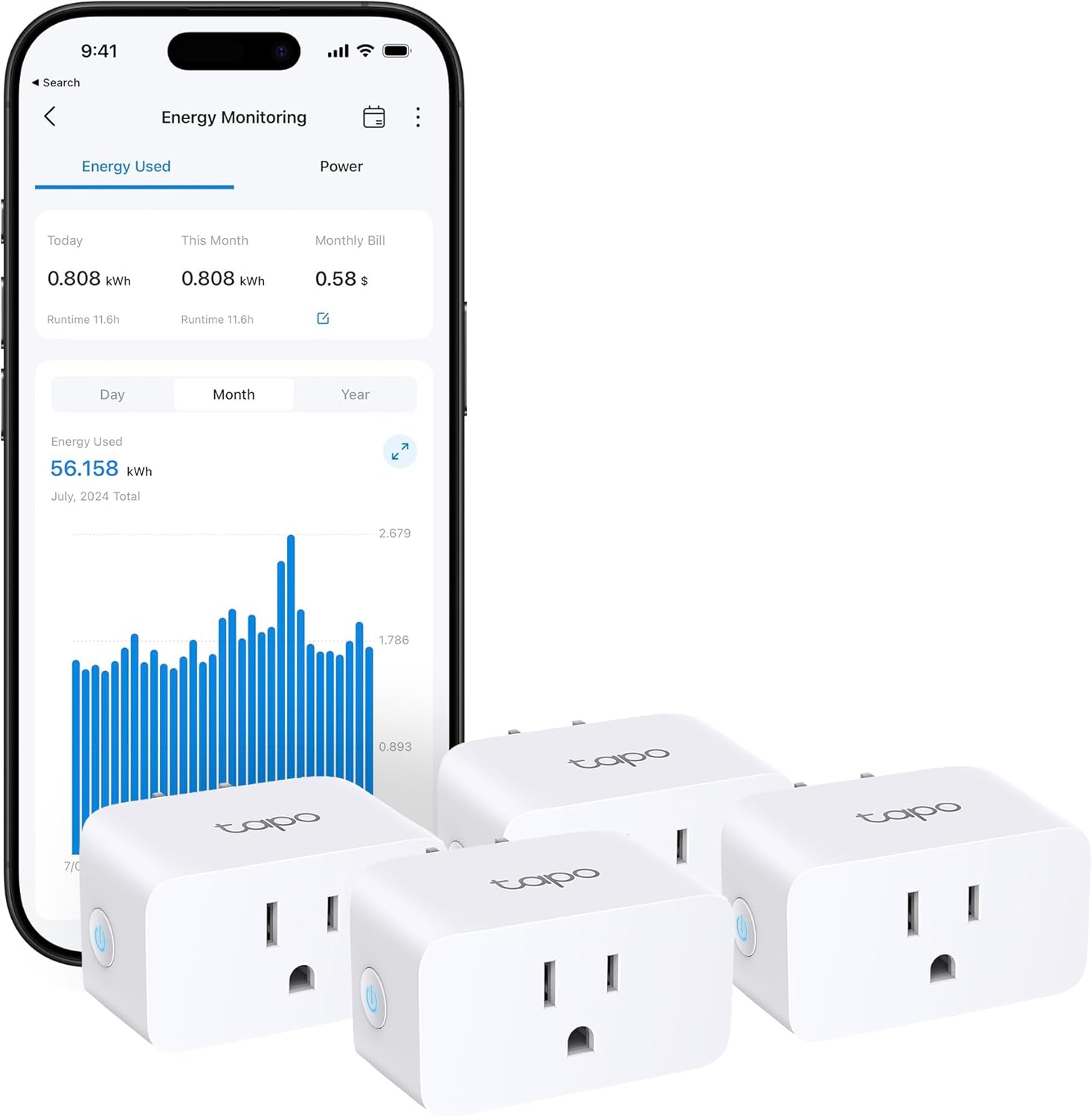
The Tapo P110M is a 4-pack of Matter-certified Wi-Fi smart plugs rated at 15A (1800 watts) with built-in energy monitoring. It suits homeowners who want to automate lamps and appliances, track consumption, and control everything by voice through Alexa or Google Assistant.
Pros & Cons
Pros
Matter compatibility gives flexibility across major smart home ecosystems
Energy monitoring makes it easy to spot wasteful devices and track usage over time
Compact footprint keeps adjacent outlets free for other plugs
Simple setup through the Tapo app with voice assistant support
Cons
The 15A, 1800-watt limit means it is not suited to very high-draw appliances such as space heaters or large air conditioners
Bill estimates are based on entered rates and readings, so they are approximations rather than exact utility figures
Control depends on a stable Wi-Fi connection, and the plugs stop being manageable remotely if the network goes down
Detailed Review
The Tapo P110M is a four-pack of Wi-Fi smart plugs built for people who want to automate everyday lamps, fans, and small appliances while keeping an eye on energy use. Its Matter certification makes it a practical choice for mixed smart home setups, since it works with Alexa, Google Home, Apple HomeKit, and Samsung SmartThings.
The standout feature is the energy monitoring. Detailed statistics and visuals show how much each connected device consumes, and scheduling can shift high-draw devices to off-peak hours. Overcharge prevention and customizable power thresholds add a layer of protection for the devices plugged into it.
Physically, the plugs are small at roughly 1.5 by 1.5 by 2.6 inches, so they rarely block a neighboring outlet. The polycarbonate housing and copper contacts feel typical of budget-friendly smart plugs, and the included FCC, RoHS, and UL certifications add reassurance on safety and compliance.
The main limitation is the 15A rating, which caps the load at about 1800 watts, so space heaters and similar high-power appliances are a poor match. The bill estimation feature also depends on the rates and readings you enter, so it will not match your utility statement exactly.
For most homeowners who want reliable voice control, scheduling, and useful energy insights across several outlets, the Tapo P110M four-pack is a strong and affordable option. Buyers planning to power heavy appliances should look for a higher-rated plug instead.
The SONOFF S61s is a 15A Matter-compatible Wi-Fi smart plug with built-in energy monitoring, sold in a 4-pack. It suits households that want to automate lamps, fans, and small kitchen appliances across Apple Home, Alexa, Google Home, or SmartThings without buying a separate hub.
Pros & Cons
Pros
Broad compatibility with major smart home platforms through Matter, reducing ecosystem lock-in
Energy monitoring gives practical insight into appliance power use directly in the app
No hub required, which keeps the setup simple and the total cost of entry low
Multi-pack value makes it practical to equip several rooms at once
Two-year warranty adds confidence for a device that stays plugged in continuously
Cons
Rated IP20, so it is suitable only for dry indoor locations and not for kitchens near water, bathrooms, or outdoor use
Requires a 2.4GHz Wi-Fi network, which may not suit users who run only 5GHz networks
Setup and advanced control rely on the eWeLink app or a Matter controller, which adds an extra app to manage for some users
Detailed Review
The SONOFF S61s is a Matter-certified smart plug designed for people who want to automate everyday plug-in devices without committing to a single smart home ecosystem. It is a strong fit for households using Apple Home, Alexa, Google Home, or SmartThings, since Matter over Wi-Fi allows it to work across these platforms.
Its standout feature is the combination of energy monitoring and 15A capacity. You can track real-time power draw and estimated electricity costs in the app, which makes it easier to identify appliances that run up your bill. The 15A rating comfortably covers lamps, fans, space heaters, and countertop kitchen gear.
The build is practical rather than premium. The plastic housing is compact at roughly 2.36 by 1.5 by 2.13 inches, and the plug-in design means no wiring is required. The IP20 rating and plastic construction make it appropriate for dry indoor spaces, but it should be kept away from moisture and outdoor weather.
There are a few trade-offs to consider. The plug only connects to 2.4GHz Wi-Fi, which can be inconvenient on modern dual-band routers, and setup relies on the eWeLink app or a Matter controller. Users looking for a fully hub-based or cloud-free system may want to look elsewhere.
Overall, the S61s offers solid value for a 4-pack of Matter-compatible plugs with energy monitoring and a two-year warranty. It is best suited to smart home users who want cross-platform compatibility and useful power tracking for indoor appliances.
The Kasa KP125MP4 is a 4-pack of Matter-certified Wi-Fi smart plugs rated for 15A and 1800W, with built-in energy monitoring. It suits homeowners building a multi-platform smart home who want local Matter control and voice support from Alexa, Google Assistant, Siri, or SmartThings.
Pros & Cons
Pros
Strong multi-platform compatibility through Matter, reducing the need for separate hubs or apps
Energy monitoring adds insight into usage patterns that basic smart plugs do not provide
Local control continues working during internet outages for supported Matter devices
Value in a 4-pack with a 2-year warranty and UL-certified safety design
Cons
Rated for a 104 °F upper operating temperature, so placement in very hot areas may be a concern
Limited to 15A and 1800W, making it unsuitable for high-draw devices such as space heaters or large air conditioners
Matter setup and full feature use depend on the chosen platform and app, which can add some initial configuration time
Detailed Review
The Kasa KP125MP4 is a four-pack of Matter-certified Wi-Fi smart plugs designed to turn ordinary lamps, fans, and small appliances into voice- and app-controlled devices. It is best suited for homeowners who already use, or plan to use, multiple smart home ecosystems and want one set of plugs that works with all of them.
Its standout feature is Matter compatibility, which allows the plugs to work with Apple Home, Amazon Alexa, Google Home, and Samsung SmartThings. Local control means supported devices can keep responding on your network when the internet is down, which is a practical advantage over cloud-dependent plugs. The built-in energy monitoring also helps you see how much power connected devices draw over time.
The plug has a compact body that avoids blocking neighboring outlets, and its UL-certified flame retardant housing adds reassurance for everyday use. The 15A and 1800W rating covers most lamps, electronics, and small appliances, but it does not extend to high-draw equipment. The 104 °F upper temperature rating also means placement in hot spaces should be considered.
Setup is straightforward once you choose your platform, though Matter pairing and feature availability can vary depending on your hub and app. Users who need heavy-duty switching or who plan to run space heaters will need a different solution. For everyday smart lighting and appliance automation across several ecosystems, this four-pack offers strong value with a 2-year warranty.
The Emporia EMSO1-4 is a four-pack of 15A WiFi smart plugs that add app control, on/off scheduling, and per-device energy monitoring to lamps, fans, and small appliances. It suits homeowners who want to cut standby power and automate routines on a 2.4GHz network, but buyers with 5GHz-only routers or outdoor needs should look elsewhere.
Pros & Cons
Pros
Combines smart control and energy monitoring in a single plug, so no separate meter is needed
Simple setup through the app with support for both Alexa and Google Home
Four units in one package make whole-room or multi-device automation affordable
Scheduling works reliably for daily routines once configured
Cons
Only supports 2.4GHz WiFi, so 5GHz-only networks will not connect
IP20 rating means indoor use only, with no protection against moisture or dust
Detailed Review
The Emporia EMSO1-4 is a four-pack of WiFi smart plugs designed for homeowners who want to control everyday devices from a phone or voice assistant. Each plug handles 10A continuous loads, so it works well with lamps, fans, humidifiers, and similar small electronics.
The standout feature is per-device energy monitoring, which reveals how much power each appliance draws and where standby consumption adds up. Built-in scheduling lets you automate routines like morning coffee or evening lighting, and the Emporia app provides real-time status for checking devices from anywhere. Voice control through Alexa and Google Assistant rounds out the experience.
The plugs are made of plastic with brass contacts and carry an IP20 rating, which means they are built for dry indoor spaces. The compact size, about 2 by 3.3 inches, keeps them from blocking adjacent outlets in most setups. Certifications from ETL and FCC add reassurance on safety and compliance.
The biggest limitation is the 2.4GHz-only WiFi requirement, which may require router adjustments for modern dual-band networks. The indoor-only rating also rules out patio or garage uses where moisture is a concern.
For households that want affordable automation with useful energy insight, the Emporia EMSO1-4 delivers solid value across four plugs. Buyers with a 2.4GHz network and indoor needs will get the most from it, while those with stricter connectivity demands should weigh the drawbacks carefully before purchasing.
The Govee H5086 is a 15A, 120V WiFi and Bluetooth smart plug that tracks real-time power, current, and voltage for connected devices through the Govee Home App. It suits people who want to monitor energy use, schedule appliances, or control high-draw devices like coffee makers by voice, but it only works on 2.4GHz Wi-Fi networks.
Pros & Cons
Pros
Detailed energy monitoring with historical data helps identify power-hungry devices and reduce waste.
Reliable remote access and voice control with Alexa and Google Assistant after a one-time setup.
Handles high-wattage appliances rated at 15A, making it versatile beyond simple lamps.
Simple plug-in design requires no wiring, and the compact size leaves the adjacent outlet free.
Cons
Supports only 2.4GHz Wi-Fi networks, so users with a 5GHz-only router will need to adjust their network settings.
The IP00 rating means no protection against moisture or dust, so it is limited to dry indoor locations.
Full functionality depends on the Govee Home App and a stable connection, which may frustrate users who prefer fully offline operation.
Detailed Review
The Govee H5086 is a 15A, 120V smart plug that adds remote control, scheduling, and energy monitoring to any standard outlet. It is aimed at homeowners who want to lower electricity use, automate lamps and small appliances, or operate devices by voice without replacing hardwired fixtures.
Its standout feature is the per-device energy tracking, which reports real-time power, current, and voltage and stores history from one day up to one year in the Govee Home App. Connection works over both Wi-Fi and Bluetooth, so setup is straightforward and control from outside the home is reliable once the plug is online.
The build is a compact white plastic housing with stainless steel contacts and fire-resistant materials, measuring about 2.68 by 2.36 by 1.5 inches. It feels solid for an inexpensive plug and does not block the neighboring outlet, though the IP00 rating confines it to dry indoor spaces.
The main drawbacks are the 2.4GHz-only Wi-Fi requirement, which can be a hurdle on modern dual-band routers, and the dependence on the app for full functionality. Users who only need basic on and off control may find simpler plugs sufficient.
For most households that want measurable energy insight and dependable voice or app control at a modest cost, the Govee H5086 is a well-rounded choice. Confirm your router supports 2.4GHz before buying, and it will serve well for kitchen appliances, lamps, and holiday decorations.
The meross MSS315 is a Matter-certified Wi-Fi smart plug with a built-in power meter that tracks real-time and historical energy use through the Meross app. It suits smart home users who want one plug that works across Apple Home, Alexa, Google Home, and SmartThings, especially anyone who values local control and offline operation.
Pros & Cons
Pros
Broad Matter compatibility makes it a flexible choice for mixed smart home ecosystems
Energy monitoring provides useful usage data without needing a separate meter
Local LAN control and no cloud dependency protect privacy and keep basic functions working during internet outages
Four-pack and 2-year manufacturer warranty add good value for whole-home deployment
Cons
Matter over Wi-Fi requires a 2.4GHz network and IPv6 support, and it does not support Thread
A Matter-compatible hub is needed for certain platforms, which may add cost for some users
The plug has an IP00 rating, so it is suitable for indoor dry locations only, and setup requires iOS 16.1 or later or Android 8.1 or higher
Detailed Review
The meross MSS315 is a Matter-certified smart plug designed for homeowners who want to bring lamps, fans, coffee makers, and other standard appliances into a connected home without committing to one ecosystem. Because it supports Matter, it can be controlled from Apple Home, Alexa, Google Home, and SmartThings, which makes it a practical choice for households that already mix several platforms.
The standout feature is the built-in power meter. Real-time wattage and historical usage data in the Meross app make it easy to spot standby drain and identify appliances that consume the most energy. The Echo-based zero touch setup also removes much of the usual friction, provided your purchase account matches your Echo account.
Build quality reflects its intended use. The polycarbonate body feels solid, and the compact footprint means it will not crowd neighboring outlets. The V0-rated fire-retardant material and built-in overload and short-circuit protection add reassurance for daily use. Keep in mind that the IP00 rating means it is strictly for dry indoor spaces.
The main drawbacks involve network and platform requirements. Matter over Wi-Fi needs a 2.4GHz network with IPv6 support, Thread is not supported, and some platforms require a separate Matter hub. Users with complex or newer network setups may need extra configuration time before the plugs work as intended.
Overall, the meross MSS315 is a strong pick for smart home users who want multi-platform compatibility, local control, and energy insights in a reliable, affordable four-pack. If your network meets the requirements, it delivers solid value and flexibility.
The ELEGRP 6-pack is a 2.4GHz Wi-Fi in-wall smart outlet set with built-in energy monitoring that works with Alexa and Google Assistant without a hub. It suits homeowners who want to control lamps, fans, or appliances by voice or app, with independent control of the top and bottom sockets on each unit.
Pros & Cons
Pros
Works directly with Alexa and Google Assistant without a separate hub
Dual sockets offer independent scheduling and control in one wall position
Built-in energy monitoring helps track and reduce electricity usage
UL and cUL certified for North American electrical safety standards
Cons
Requires a 2.4GHz Wi-Fi network, so 5GHz-only networks will not connect
In-wall installation involves working with household wiring, so a licensed electrician may be needed for some homes
Compatibility is listed as 'All' in the specifications, so confirm your specific devices work with the app before buying in bulk
Detailed Review
The ELEGRP Smart In-Wall Outlet is a set of six Wi-Fi receptacles designed to replace standard wall outlets with app and voice-controlled ones. It is aimed at homeowners who want to bring lamps, fans, and appliances into a smart home setup without installing a separate hub.
Each outlet has two independently controlled sockets, so you can schedule a lamp on the top socket and a TV on the bottom one. Built-in energy metering adds useful insight, letting you see which devices draw the most power and where you can cut back on waste.
The build uses brass and polycarbonate, and the outlets carry UL and cUL certification along with fire-resistant materials and surge protection. The white finish blends into standard wall plates, so the result looks like a conventional outlet once installed.
Installation is the main drawback, since these outlets replace wall receptacles and require comfort with household wiring. The 2.4GHz-only Wi-Fi requirement and the broad 'All' compatibility listing also mean you should verify your devices and network before committing to the full set.
For buyers who want reliable, hub-free voice control and per-socket scheduling across multiple rooms, this six-pack is a practical choice. Its certification, energy monitoring, and strong user rating make it a solid investment for a whole-home upgrade.
The Eve Energy Strip is a 3-outlet smart power strip for Apple HomeKit that adds per-outlet control, scheduling, and energy metering with built-in surge, overcurrent, and overvoltage protection. It suits Apple users who want to automate lamps, fans, and standby electronics without a separate hub.
Pros & Cons
Pros
Seamless integration with Apple HomeKit, Siri, and the Home app for a polished, privacy-focused experience
Per-outlet energy monitoring helps identify and eliminate standby power waste
Direct Wi-Fi connection means no extra hub is required for basic use
Multiple layers of electrical protection give peace of mind for computers, entertainment systems, and appliances
Solid build with a 2-year warranty and a high average customer rating
Cons
Requires an iPhone or iPad with a current iOS or iPadOS version, so it is not suited to Android or non-Apple households
Carries a premium price compared with basic or non-smart power strips offering only three outlets
Only three outlets and a 6.3 ft cable limit placement flexibility and may not fit larger setups
Detailed Review
The Eve Energy Strip is a smart triple-outlet power strip designed for people who already live inside the Apple Home ecosystem. It gives each of its three outlets independent control, so you can switch a lamp, a fan, or a charger from your iPhone, Apple Watch, or with a Siri command. It is a practical choice for HomeKit owners who want automation without adding another bridge or gateway.
The standout feature is the combination of scheduling and energy monitoring. You can align connected lights and fans with your daily routine, and use a home hub to simulate presence while you travel. The built-in power meter shows total consumption and projected cost, which makes it easy to find devices that draw power on standby and shut them off.
Build quality feels appropriate for a device in this class, with an aluminum and plastic enclosure and a clearly labeled set of onboard buttons. The 6.3 ft cable and widely spaced outlets accommodate bulky power adapters, which is a common weakness in cheaper strips. Surge, overcurrent, and overvoltage protection add a layer of safety that basic smart plugs cannot match.
The main drawbacks are the Apple-only requirement and the cost. Anyone using Android or a mixed-platform home will get little value from it, and buyers who only need one or two remote-controlled outlets may find individual smart plugs more economical. The short cable and fixed three-outlet layout also limit flexibility in larger entertainment or workstation setups.
For Apple households that want a dependable, privacy-conscious smart power strip with real energy insight, the Eve Energy Strip is a strong and well-reviewed option. Buyers who value protection, scheduling, and HomeKit integration will likely find it worth the premium. Those outside the Apple ecosystem should look at alternatives.
The THIRDREALITY 15A Zigbee Smart Plug is a wall-plug switch that reports real-time power usage and doubles as a Zigbee repeater to strengthen your mesh network. It suits owners of Echo, Home Assistant, SmartThings or Hubitat setups who want energy monitoring on a budget, but it will not work without a compatible Zigbee hub.
Pros & Cons
Pros
Accurate energy monitoring with support for Home Assistant, SmartThings and Hubitat gives useful insight into appliance usage.
Zigbee repeater function improves network coverage for other smart devices in the home.
Simple setup with Echo devices, where a voice command discovers the plug automatically.
Affordable price for a certified, 15A plug with monitoring features that often cost more elsewhere.
Cons
A Zigbee hub is required, and Echo devices only work if they have a built-in Zigbee hub, so this is not a standalone Wi-Fi plug.
Power monitoring and the restore-state setting are only supported on specific platforms, so check compatibility before buying.
The listed wattage of 21600 watts does not match the 15A at 120V rating, which works out to about 1800 watts, so rely on the amperage figure. The IP20 rating also means it is for indoor, dry locations only.
Detailed Review
The THIRDREALITY Zigbee Smart Plug is a 15A wall-mounted outlet switch built for people who already run a Zigbee-based smart home. It works with Echo devices that have a built-in hub, along with Home Assistant, SmartThings, Hubitat and several other platforms.
Its standout feature is real-time power monitoring, which tracks how much energy a connected appliance draws. This makes it easy to find energy-hungry devices and adjust usage habits. The built-in Zigbee repeater also helps strengthen the mesh network, which is useful in larger homes.
The plug has a compact, space-saving body that leaves the neighboring socket free. The white plastic housing feels solid for its size, and the ETL certification adds reassurance for everyday use. Setup is quick when paired with an Echo device, since a simple voice command discovers the plug.
The main drawbacks are the dependency on a compatible Zigbee hub and the uneven platform support for monitoring and restore-state features. The IP20 rating also limits use to dry indoor spaces. Its listed wattage figure is inconsistent with the 15A rating, so buyers should use the amperage specification as the reliable guide.
Overall, this is a practical and affordable choice for Zigbee users who want energy monitoring and better network coverage in one plug. Buyers who do not own a compatible hub should look at Wi-Fi or Matter-based alternatives instead.
The GHome Smart Plug delivers reliable voice control and remote automation. With easy setup, accurate scheduling, and multi-app compatibility, it's ideal for anyone looking to automate lighting, fans, or seasonal decorations without complexity.
Pros & Cons
Pros
Extremely easy setup process that takes just minutes to connect and pair with voice assistants
Highly accurate timer and scheduling functions perfect for reptile lighting, Christmas decorations, and daily routines
Responsive app interface with 1-second activation speed for instant control
Affordable 4-pack pricing makes automating multiple rooms cost-effective
Reliable performance with minimal disconnection issues when using stable 2.4GHz WiFi
Cons
Requires 2.4GHz WiFi only, not compatible with 5GHz networks, which may limit placement in some homes
Cannot connect directly to Alexa or Google Home without first setting up through the GHome app
No physical remote included, requiring users to rely on app or voice commands for control
Detailed Review
The GHome Smart Plug is a compact WiFi outlet switch designed for homeowners seeking simple automation without technical complexity. This 4-pack is ideal for controlling lamps, fans, humidifiers, Christmas lights, and other plug-in appliances throughout your home. At just over 2 inches square, it fits most standard outlets without blocking adjacent sockets.
Setup is remarkably straightforward. Users connect the plug to a 2.4GHz WiFi network, then pair it with Alexa or Google Home through the GHome app in minutes. Real-world reviewers consistently praise the fast connection and reliable performance. The scheduling feature is exceptionally accurate, with customers reporting precise on/off timing down to the second, making it perfect for reptile lighting or daily automation routines. Voice control works instantly, with app responses occurring within one second of issuing a command.
Build quality is solid plastic construction rated for 10 amps and 1200 watts, meeting ETL and FCC safety standards. The compact form factor and simple push-button design make installation foolproof. Group control functionality allows managing multiple plugs simultaneously, and family sharing enables household members to access the same devices through their phones.
The main limitation is the 2.4GHz WiFi requirement. Homes with only 5GHz networks cannot connect these plugs, and older WiFi routers may struggle. Additionally, direct voice control requires initial app setup rather than immediate pairing. Some users note that a physical remote would enhance convenience, though the app interface compensates adequately.
The GHome Smart Plug delivers exceptional value for automation beginners and experienced smart home users alike. Its ease of use, reliable performance, and affordable pricing make it a top choice for anyone wanting to automate seasonal decorations, improve energy efficiency, or add voice control to household lighting without complicated installation or setup processes.
Specifications
Connectivity & Control WiFi Protocol: 2.4GHz only Voice Assistants: Amazon Alexa, Google Assistant Control Methods: App (GHome/Smart Life/Tuya), Voice, Touch Button Connection Type: WiFi with Bluetooth fallback
Electrical Specifications Operating Voltage: 120V Current Rating: 10A Maximum Wattage: 1200W Switch Type: Push Button ON-OFF Contact Type: Normally Open
Physical & Safety Dimensions: 2.1 x 2.1 x 1.1 inches Material: Plastic IP Rating: IP40 (dust and water resistant) Certifications: ETL, FCC Temperature Rating: Up to 1382 degrees F Package Contents: 4 smart plugs, instruction manual
Buyer Guide
Best For Automating seasonal decorations like Christmas lights, controlling reptile habitat lighting, managing lamps and fans with voice commands, saving energy through scheduled on/off cycles, and creating smart home routines without complex wiring or installation.
WiFi Requirements These plugs require a stable 2.4GHz WiFi network. If your router only broadcasts 5GHz, you will need a dual-band router or separate 2.4GHz network. Ensure your WiFi signal reaches the outlet location, as weak signals cause disconnections.
Setup Process Download the GHome app, create an account, add each plug to your WiFi network, then link to Alexa or Google Home through the app. Total setup time is typically 5-10 minutes per plug. Keep the instruction manual handy for the first plug, as the process becomes automatic for subsequent units.
Scheduling Tips Use the timer function for daily routines like turning lights on at sunrise or off at bedtime. Create groups for multiple plugs controlling related devices, such as all bedroom lights or outdoor decorations. Test schedules before relying on them for critical applications.
Compatibility Check Verify your voice assistant is supported (Alexa or Google Home), confirm your WiFi is 2.4GHz, and check that your outlet is easily accessible. Avoid using these plugs with devices requiring constant power, like refrigerators or security systems.
Energy Monitoring Smart Plug Buying Guide
Energy tracking features
Look at what the listing says the plug measures and how it presents that information. The Tapo P110M energy monitoring smart plug listing describes in-depth statistics and an option to estimate costs by integrating with billing systems, with both single and periodic readings. The Govee energy monitoring smart plug listing states that it tracks real-time power, current and voltage, and that its history can be viewed daily, weekly, monthly, and for up to one year. Those two details give you very different views of the same appliance, so decide which view you need before you compare other features.
Connection type decides which hub or network you need. Several listings in this group are Wi-Fi only. The SONOFF S61s Matter smart plug listing says it connects directly over 2.4GHz Wi-Fi without a separate hub, and it also lists Matter support. The Emporia energy monitoring smart plug listing says it requires a 2.4GHz network and does not support 5.0GHz networks. The ThirdReality Zigbee smart plug listing is different: it uses Zigbee and states that a Zigbee hub is required. If you do not already run a hub, that requirement matters before you buy.
Matter is a shared standard. Listings for the Kasa, meross and Tapo plugs in this group all name Matter in their connectivity or feature text, but each listing lists its own supported ecosystems, so confirm the platform you use appears there.
Load rating and what the listing states
Check the current rating before you plug in a high-draw appliance. The Emporia listing gives a 10A maximum continuous load and says a 15A peak load is allowed for up to one hour per day. Most other plugs in this group list a 15A rating. Read the exact wording on the listing, and follow the appliance manufacturer’s manual for what it can safely draw.
Wattage figures also vary by listing. The Tapo listing shows 1800 watts, and the SONOFF listing shows 1875 watts. Compare those numbers with the appliances you plan to connect, and do not treat a plug’s rating as a guarantee for every device.
Control, scheduling and setup
Most listings describe app control, scheduling and voice commands. The meross Matter smart plug listing describes a setup option that works with Amazon Echo, and it notes that this option requires the purchase account to match the Echo account. If the accounts do not match, the listing says standard Matter pairing is still available. The Kasa Matter smart plug listing describes control through the Kasa app and voice commands with several assistants. The Govee listing also covers Wi-Fi and Bluetooth connection, and it states that 5G Wi-Fi is not supported.
Safety statements vary. The Kasa listing mentions a UL-certified flame-retardant design and a 2-year limited warranty. The Govee listing says it holds FCC and ETL certifications and uses fire-resistant materials. The meross listing says it uses V0-rating fire-retardant materials and provides protection against short circuits and overloads. These are statements from each manufacturer. Check the certification marks on the product and in the manufacturer’s documentation before relying on them, and follow the manual for installation and use.
For a setup that centers on a wide device mix and cost estimates, the Tapo P110M energy monitoring smart plug listing describes the most features tied to billing and scheduling. If you want Matter support with Wi-Fi and no separate hub, the SONOFF S61s Matter smart plug and Kasa Matter smart plug listings are the ones to compare on connectivity and voice control. For a smaller space or a single outlet with a stated 10A continuous rating, the Emporia listing is worth examining closely.
If you already run a Zigbee hub, the ThirdReality Zigbee smart plug listing describes real-time power monitoring that some hubs support. Check each listing for current pricing and full specifications before you buy.
Frequently Asked Questions
What do energy monitoring smart plugs measure?
Listings describe measurements such as real-time power, and some also mention current, voltage and historical data. The exact measurements depend on the model, so check the listing for what it reports.
Do these plugs need a hub?
It depends on the connection type. Several listings in this group are Wi-Fi based and state that no separate hub is needed. The ThirdReality listing states that a Zigbee hub is required.
Do I need 2.4GHz Wi-Fi?
Some listings require it. The Emporia listing says 5.0GHz networks are not supported, and the SONOFF listing describes connection over 2.4GHz Wi-Fi. Check the listing for the network type before you buy.
Can these plugs be used with voice assistants?
Many listings describe voice control with Amazon Alexa, Google Assistant or other platforms. Confirm that the assistant you use is named on the specific product’s listing, and read the manufacturer’s setup instructions.
About Colin Foster
Colin Foster is part of our editorial team and reviews and edits our smart home guides, checking product details against manufacturer specifications and owner feedback.
Learn what smart plugs can and cannot do. Control lamps, fans, and holiday lights remotely. Avoid space heaters. Understand load ratings, energy monitoring, outdoor plugs, and Matter compatibility.
Planning security camera installation for home? Compare three practical options by setup type, features and fit, with a buying guide to help you choose.
Learn how to install home security camera systems fast. We compare six top picks by setup ease, power, storage and Alexa compatibility to help you choose.
Compare 7 smart thermostat for electric baseboard heat options by compatibility, wiring, scheduling and voice control to find the right fit for your home.
Compare 4 security camera and recorder setups for home monitoring. See which recorder fits PoE, analog or hybrid camera systems, and what to check before buying
Compare 7 sign for security camera options for driveways, gates and entryways. Specs, pros, cons and buying tips to help you pick the right warning sign.
Compare five 4K security camera wireless options for home monitoring. Covers battery, solar, no-subscription setups, AI detection and buying factors to help you

 By Colin Foster