Some links on this page are affiliate links. If you buy through them, we may earn a commission at no extra cost to you. As an Amazon Associate I earn from qualifying purchases. Learn more ›
Whole-Home Energy Monitors: Clamp Sensors and What They Measure
CT clamp monitors measure current at your electrical panel to show whole-home energy use. They require electrician installation and provide detailed consumption data.
Whole-home energy monitors let you track your household electricity usage in real time. These systems use current transformer (CT) clamps that attach around electrical wires in your main panel. The clamps measure the magnetic field created by flowing current and convert that reading into power data you can view on a smartphone app or dashboard. This article explains how CT clamp monitors work, what they can and cannot measure, why a licensed electrician must install them, and how smart meter data compares as a simpler alternative.
How CT Clamp Sensors Measure Current
A CT clamp is a donut-shaped sensor that snaps around a single electrical conductor. When current flows through the wire, it generates a magnetic field. The clamp detects that field and produces a low-voltage signal proportional to the current. The monitor’s processing unit reads that signal, multiplies it by the measured voltage (from a separate voltage tap or a known line voltage), and calculates power in watts. Over time, the system totals energy consumption in kilowatt-hours.
Most whole-home monitors come with two large clamps designed for the main feeder cables — one for each phase (hot wire) in a standard 120/240-volt residential panel. A residential service in the United States typically has two 120-volt hot legs and a neutral. The monitor needs a clamp on each hot leg, because current flows on both.
The voltage reference is usually obtained by plugging a small power supply into a nearby outlet, or by connecting a voltage tap directly inside the panel. The monitor then uses the known voltage to convert the current reading into power. Accuracy depends on proper clamp placement and on the monitor’s ability to sample current and voltage fast enough to capture changes. Sampling rates differ between models, but most provide useful data for household tracking.
What the Monitor Can Show You
Whole-Home Energy Use
With just the two main clamps, a monitor shows your entire home’s total electricity consumption. You see real-time wattage, daily and monthly totals, and historical trends displayed as graphs. This overview helps you identify high-usage periods and compare your daily patterns. For example, you might notice a spike in the afternoon when your air conditioner runs, or a steady baseline from appliances like refrigerators and always-on electronics.
Individual Circuit Monitoring
Most systems allow you to add extra clamps on individual circuit breakers. If you install a smaller CT clamp on the wire leaving a specific breaker, you can track that circuit’s usage separately. Common circuits to monitor include the HVAC system, water heater, electric vehicle charger, oven, or a dedicated workshop. With multiple circuit clamps, the monitor subtracts the sum of those circuits from the total to show the rest of the home’s usage. This gives you a breakdown without needing a clamp on every wire.
Solar Production Tracking
If you have solar panels, many whole-home monitors can measure solar production as well. You install clamps on the wires coming from your solar inverter, configured as a production channel in the monitor’s software. The monitor then shows both consumption and generation side by side. Some systems also detect net flow to and from the utility grid, so you can see when you are exporting power. This feature requires careful clamp orientation to distinguish incoming and outgoing current.
Voltage and Power Factor
Some advanced monitors also report voltage levels and power factor (how efficiently your home uses electricity). Voltage data can help you spot problems like high or low utility voltage that might affect equipment. Power factor readings are less common in simple monitors but can indicate lagging performance from motor loads. For most homeowners, the most useful data is real power (watts), which is what the utility bills you for.
Installation Requires a Licensed Electrician
The inside of an electrical service panel contains exposed live conductors carrying lethal voltage — typically 120 to 240 volts. Even with the main breaker turned off, the utility side of the main breaker and the meter socket remain live unless the utility drops service. For this reason, installing CT clamps inside the panel is not a DIY job. A licensed electrician knows how to safely open the panel, route the clamp wires, and avoid contact with energized parts.
The installation process involves turning off the main breaker, verifying the panel is de-energized with a non-contact voltage tester, then opening the panel cover. The electrician clips the two main CT clamps around each hot feeder wire, taking care to orient them correctly (direction of current flow matters for solar or net metering setups). For circuit-level monitoring, they also clip smaller clamps around the individual branch circuit wires. The clamp wires are then routed out of the panel through a knockout and connected to the monitor’s processing unit, which is typically mounted nearby.
If you want circuit-level monitoring, you must also decide which breakers to monitor before installation. The electrician needs to know which circuits you care about so they can buy enough clamps and place them correctly. After installation, you will pair the monitor with your home Wi-Fi and set up the app. Many monitors include a pairing procedure where you connect the device to your network and then configure which clamp corresponds to which circuit.
Important safety note: Never attempt to open your electrical panel yourself. Hire a licensed electrician who is familiar with energy monitor installation. The cost of professional installation is a necessary expense for a safe and reliable setup.
Device Detection Limits
CT clamps measure total current on a wire — they do not identify individual devices behind that circuit. For example, if you monitor your kitchen outlets circuit, the monitor shows the combined wattage of your refrigerator, microwave, coffee maker, and anything else plugged into that circuit. You cannot see which appliance is responsible for a spike unless you manually turn devices on and off while watching the live data.
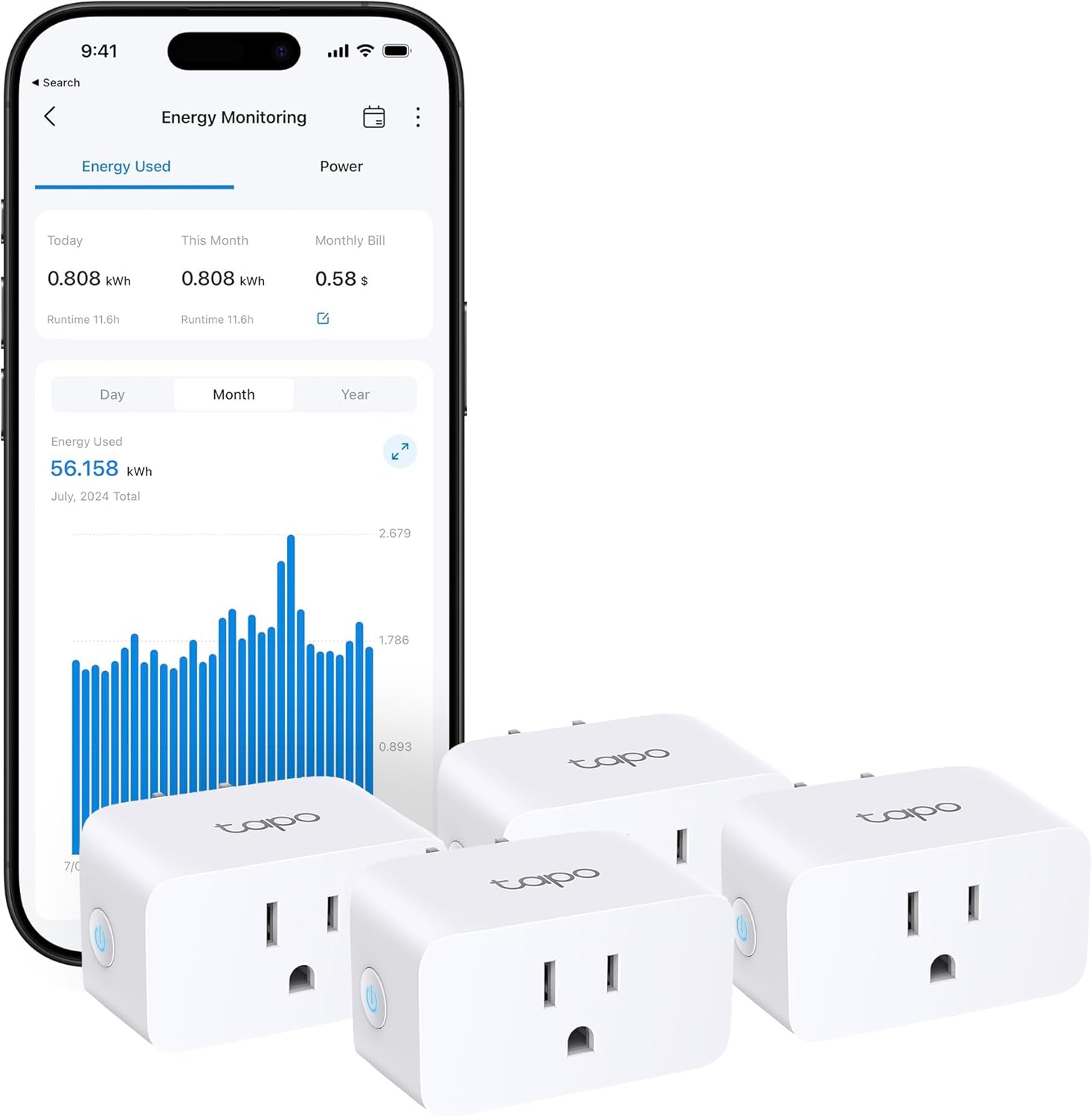
Some monitors use machine learning to try to disaggregate loads by analyzing electrical signatures, but this feature is not standard and often requires a subscription service. The accuracy of load disaggregation varies and many users find it unreliable for distinguishing similar devices. For precise device-level data, you need a smart plug or a dedicated appliance monitor on each appliance.
Another limitation: clamps belong only on the conductors the manufacturer specifies. A clamp on a neutral or ground wire gives misleading readings, and 240-volt or multi-wire branch circuits may need two clamps or a specific setting in the app. Always follow the manufacturer’s guidance on clamp placement.
Also, monitors rely on stable Wi-Fi to send data to the cloud and to your app. If your Wi-Fi goes down, the monitor may continue recording locally but you may not see live data until connectivity resumes. Many models store data onboard and upload later, but you should check the specifications if offline access matters to you.
Smart Meter Data as an Alternative
If you prefer not to install a dedicated energy monitor, you can often get similar whole-home data from your utility’s smart meter. Most utilities that have installed smart meters make usage data available online, often with hourly or daily breakdowns. Some utilities can provide near-real-time data through an opt-in program or a separate portal. Smart meter data is free and requires no equipment or installation.
However, smart meter data has limitations. It typically updates every 15 minutes to one hour, not in real time. You cannot see instant wattage when turning on a device. It also does not offer circuit-level information — you only get total home consumption. For solar homes, the smart meter may only show net import/export, not total production. A dedicated CT clamp monitor gives you much finer granularity and control.
If you just want to understand your monthly bills and identify general trends, smart meter data is sufficient. But if you want to actively reduce consumption by seeing real-time effects, or if you need circuit-level tracking for electric vehicle charging or HVAC usage, a CT clamp monitor is the better choice.
How Homeowners Use the Data
People install whole-home energy monitors for several practical reasons. The most common is to reduce electricity bills by identifying wasteful habits. Seeing a live display of wattage can motivate you to turn off lights, unplug phantom loads, or shift appliance use to off-peak hours. For example, a homeowner might notice that their old refrigerator is drawing more power than expected and choose to replace it.
Another use is tracking solar panel performance. With a monitor that measures solar production and home consumption side by side, you can see how much solar energy you are using directly versus exporting to the grid. This helps you decide whether to shift load to daytime hours when your panels are generating.
Some homeowners use the data to prepare for battery backup or electric vehicle charging. By monitoring the power draw of your whole home and specific circuits, you can size a battery system or know if your panel can handle a new car charger without an upgrade.
Data from energy monitors can also help you spot problems early. A sudden increase in baseline consumption when no one is home may indicate an appliance running unnecessarily, a faulty thermostat, or a leak. The trend graphs make it easy to compare day-over-day usage.
While energy monitors do not automatically control devices, some models integrate with smart home systems to trigger automations. For example, if consumption exceeds a threshold, you could receive an alert. For more advanced control (like shutting off a load when usage is high), you would need a smart switch or a load control system.
Top Picks to Compare
If you would rather start from a short list, these are popular options on Amazon for this search. Check each listing’s details, size and current price before you buy.
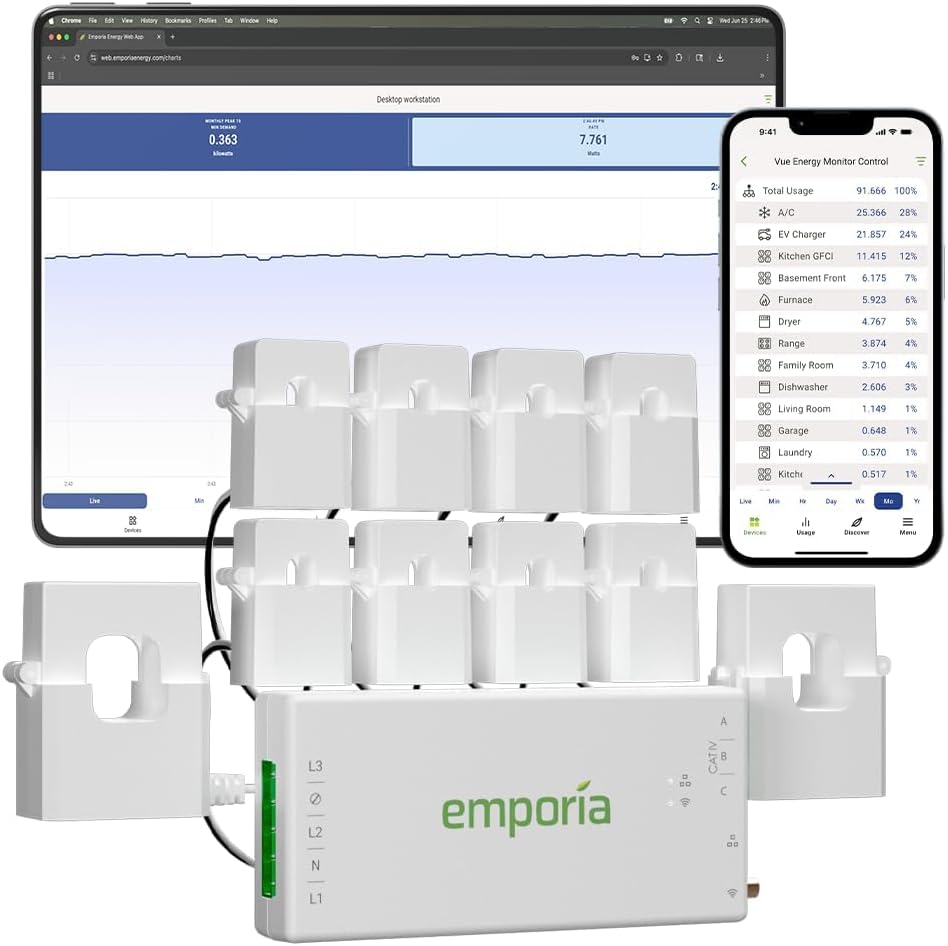
The Emporia Vue 3 is a UL-certified whole-home energy monitor that provides real-time electricity usage tracking and solar net metering through a smartphone app. Best for homeowners seeking detailed energy insights and cost savings through automated energy management.
Pros & Cons
Pros
UL certification provides genuine safety assurance for electrical monitoring
Clamp-on sensor design makes installation accessible for most homeowners
Accurate real-time reporting helps identify high-consumption circuits quickly
Solar and net metering features support renewable energy systems
App-based automation enables intelligent energy management and cost reduction
Cons
Requires 2.4 GHz WiFi and internet connection for all monitoring features
3-phase and Delta systems require additional 200A sensor purchase
1-second data retention limited to 3 hours, only available when app is actively open
Detailed Review
The Emporia Vue 3 is a whole-home energy monitoring system designed for homeowners who want detailed visibility into their electricity consumption and solar production. It's ideal for anyone looking to reduce energy costs, manage peak demand charges, or monitor renewable energy systems. The system combines hardware installation in your circuit panel with a mobile app for 24/7 energy tracking and management.
The standout feature is its UL certification, which means every component has undergone rigorous safety testing to prevent hazards like overheating and short-circuiting. The clamp-on sensor installation is refreshingly simple, requiring no rewiring of your electrical panel. With ±2% accuracy and real-time data collection, you get precise visibility into which circuits consume the most power. The app provides actionable insights, automated alerts, and integration with time-of-use and peak demand programs to help lower your electric bill.
Build quality is solid, with the monitor measuring 10 x 5 x 5 inches and designed for permanent circuit panel mounting. The system supports most single-phase and split-phase residential configurations, though 3-phase systems require an additional 200A sensor. Data retention is tiered: 1-second data stays for 3 hours, 1-minute data for 7 days, and hourly data indefinitely, with cloud export available anytime.
The main limitations are WiFi dependency and the need for a 2.4 GHz connection with active internet. If your home lacks reliable WiFi coverage near the panel, you may experience monitoring gaps. Additionally, the 3-hour retention window for real-time data means you can't review granular second-by-second history after closing the app.
The Emporia Vue 3 delivers professional-grade energy monitoring at an accessible price point. Its UL certification, ease of installation, and comprehensive app features make it a strong choice for homeowners serious about energy management and cost savings.
Specifications
Model: EMV3A-2P-8
Compatibility: iPhone, Android, Web app
Certifications: UL Listed, CE Listed
Dimensions: 10 x 5 x 5 inches
Sensor Type: Clamp-on sensors (8 included)
Supported Systems: Single phase, Single-split phase, 2-wire systems. 3-wire, 3-phase, and 4-wire Wye systems with earthed neutral supported with optional 200A sensor
Accuracy: ±2%
Data Retention: 1-second data (3 hours in app), 1-minute data (7 days cloud), 1-hour data (indefinite cloud storage)
Network Requirements: 2.4 GHz WiFi with internet connection
Warranty: 1 year
Buyer Guide
Is This Right for You? The Emporia Vue 3 suits homeowners who want granular energy data to reduce costs, monitor solar systems, or optimize usage around time-of-use rates. It's not ideal if you lack reliable WiFi coverage near your electrical panel or need instant access to historical data beyond 3 hours.
Installation Considerations: The clamp-on sensors install in your circuit panel without rewiring, making it suitable for most homeowners. However, you'll need basic comfort working near your electrical panel or should hire an electrician. Verify your home's electrical configuration (single-phase vs. 3-phase) before purchasing, as 3-phase systems require an additional sensor.
WiFi and Connectivity: Ensure your home has strong 2.4 GHz WiFi coverage near your electrical panel. The system cannot function without internet connectivity, so consider this a requirement, not optional.
Energy Savings Potential: Real savings depend on your current usage patterns and local utility rates. The app's time-of-use and peak demand automation features offer the highest savings potential, especially if your utility offers such programs.
The Fusion Energy SEM-Meter is a circuit-level energy monitoring system that tracks real-time power usage across up to 16 appliances simultaneously, making it ideal for landlords, property managers, and cost-conscious homeowners who want transparent electricity billing and consumption insights. Its standout feature is the ability to allocate costs fairly across rental units without installing multiple meters, plus optional privacy-focused MQTT operation for Home Assistant users.
Pros & Cons
Pros
Exceptional granularity with 16 independent circuit sensors reveals which appliances consume the most energy
Transparent cost allocation eliminates billing disputes in rental properties and shared living spaces
Privacy-first architecture allows local MQTT operation without internet or cloud reliance
Flexible electrical system support handles most residential and light commercial configurations
Highly accurate 1% measurement with intuitive app interface for Android and Apple devices
Cons
Requires circuit panel access and basic electrical knowledge for sensor installation, not suitable for renters without landlord permission
Limited to 16 circuits, which may be insufficient for large commercial properties or facilities with many sub-circuits
Detailed Review
The Fusion Energy SEM-Meter is a sophisticated circuit-level energy monitoring system designed for homeowners, landlords, and property managers who need precise control over electricity usage and cost allocation. It bridges the gap between basic whole-home monitors and expensive sub-metering installations, offering granular insights into individual appliance consumption without requiring multiple utility meters.
The system's standout strength lies in its 16 independent 50A sensors, which allow simultaneous monitoring of air conditioners, furnaces, water heaters, washers, dryers, ranges, and other high-draw appliances. Real-time power data streams to your smartphone via WiFi with 1% accuracy, enabling immediate identification of energy waste. The app displays consumption in multiple formats (now, day, week, month, year), making it easy to spot patterns and optimize usage. For rental properties, the customizable rate templates support peak, off-peak, and holiday pricing, automatically calculating fair electricity costs per unit or room.
Installation relies on clamp-on sensors that attach to circuit breakers, making the process straightforward for most single-phase 120/240VAC and split-phase systems. The device also supports three-phase 415Y/240VAC configurations, though Delta systems are not compatible. The compact form factor (3.1 x 1.2 x 4.18 inches) fits easily in most electrical panels. For privacy-conscious users, the MQTT mode allows local operation via Home Assistant without any cloud connectivity or app dependency.
Potential drawbacks include the need for circuit panel access, which renters cannot provide without landlord approval, and the 16-sensor limit may feel restrictive for large commercial properties. Installation requires basic electrical confidence, though it remains simpler than hiring a professional electrician. The price point is reasonable for the functionality but may deter budget-conscious buyers seeking only whole-home monitoring.
The Fusion Energy SEM-Meter delivers exceptional value for landlords managing multi-unit properties, tech-savvy homeowners pursuing energy optimization, and anyone seeking transparency in electricity consumption. Its combination of granular monitoring, fair billing automation, and privacy-first architecture sets it apart from competitors.
Specifications
Sensor Configuration: 16 x 50A clamp-on current sensors for circuit-level monitoring
Electrical Support: Single-phase up to 240VAC line-neutral, split-phase 120/240VAC, three-phase up to 415Y/240VAC (Delta not supported)
Measurement Accuracy: 1% across all monitored circuits
Connectivity: 2.4GHz WiFi, MQTT support for local operation without cloud
Mobile Apps: Native Android and Apple applications with real-time streaming
Data Storage: Hourly data retained for 90 days, daily/monthly/yearly data stored permanently
Physical Dimensions: 3.1 x 1.2 x 4.18 inches
Weight: 4.05 pounds
Warranty: 1-year manufacturer protection
Model: SEM-Meter by Fusion Energy
Best Use Cases
Rental Property Managers: Automatically calculate fair electricity costs per unit with customizable peak, off-peak, and holiday rate templates, eliminating billing disputes and ensuring transparent cost allocation across tenants.
Homeowners with Solar Systems: Monitor solar generation and net metering in real-time, track self-consumption patterns, and optimize battery charging or grid export timing to maximize savings.
Energy-Conscious Households: Identify which appliances consume the most electricity, receive actionable alerts when usage spikes, and make informed decisions about equipment upgrades or usage habits to lower monthly bills.
Home Automation Enthusiasts: Integrate with Home Assistant via MQTT for local processing without cloud dependency, enabling custom automations based on real-time power data and privacy-first architecture.
Small Commercial Properties: Light commercial three-phase monitoring available as a separate bundle, suitable for offices, retail spaces, or service facilities needing detailed energy tracking and cost allocation across departments.
The Refoss EM16P is a privacy-first energy monitoring system that integrates natively with Home Assistant and offers local control without cloud dependency. It's ideal for solar homeowners and tech-savvy users seeking circuit-level insights, real-time automation, and the ability to maximize solar self-consumption while maintaining complete data privacy.
Pros & Cons
Pros
Complete privacy control with all data stored locally on your network, no cloud subscriptions or hidden fees
Seamless Home Assistant integration requires no technical setup, making it accessible to non-expert users
Exceptional accuracy at ±1% with circuit-level insights enables precise identification of energy waste and optimization opportunities
Designed specifically for solar homes with zero feed-in automation that maximizes self-consumption and reduces grid feed-in losses
Smart alerts and customizable usage targets for each circuit help prevent appliance overages and manage peak demand
Cons
Requires Home Assistant knowledge or willingness to learn for full automation potential, limiting appeal to non-technical users
Limited to 16 branch circuits, which may be insufficient for very large homes with extensive sub-panel configurations
Detailed Review
The Refoss EM16P is a sophisticated energy monitoring system designed for homeowners who prioritize privacy, local control, and advanced automation. Unlike cloud-based competitors, this device processes all data locally through its built-in Web UI, Open API, and MQTT protocol. It's particularly well-suited for solar homeowners, tech enthusiasts, and anyone running a Home Assistant setup who wants granular control over their energy consumption without relying on external servers.
The standout feature is its native Home Assistant integration combined with new OpenClaw AI support, enabling intelligent automation that responds to real-time energy conditions. The system monitors voltage, current, active power, and power factor across up to 16 branch circuits plus 2 main circuits, delivering ±1% accuracy. Real-world performance shines in solar optimization, automatically routing surplus midday solar power to high-consumption appliances like EV chargers and water heaters. Users report identifying 10-20% monthly savings through the detailed historical data and exportable reports available directly from the device.
Build quality is solid with ETL certification and UL 61010 compliance ensuring safe operation. The non-invasive clamp-on sensors install easily without requiring an electrician, and the compact 4.5 x 3.5 x 1.1 inch form factor fits most home circuit panels. The 2-year warranty and responsive manufacturer support provide confidence in long-term reliability. Daily data storage for up to 5 years means you'll never lose historical insights needed for seasonal trend analysis.
The main limitation is that maximum value requires Home Assistant knowledge or comfort with API integration. While setup is straightforward, advanced automation features demand some technical familiarity. Additionally, the 16-circuit limit may constrain very large homes with multiple sub-panels, though this covers most residential installations adequately.
The Refoss EM16P delivers exceptional value for privacy-conscious homeowners and solar system owners seeking local energy intelligence without ongoing subscription fees. Its combination of accuracy, automation capability, and data sovereignty makes it a compelling choice in the smart energy monitoring space, particularly for users already invested in Home Assistant ecosystems.
Specifications
Model: EM16P
Dimensions: 4.5 x 3.5 x 1.1 inches
Weight: 4.24 pounds
Main Circuit Sensors: 2 sensors supporting 2-200A each
Branch Circuit Sensors: 16 sensors supporting 1-60A each
Accuracy: ±1% for 200A range (2-200A), ±1% for 60A range (1-60A), ±2% at low current
Data Storage: 5-year historical data retention with export capability
Connectivity: Built-in Web UI, Open API, MQTT protocol
Integration: Native Home Assistant support, OpenClaw AI automation
Certification: ETL certified, UL 61010 compliant
Installation: Non-invasive clamp-on sensors
Warranty: 2 years with manufacturer support
Availability: First available October 31, 2024
Buyer Guide
Who Should Buy: The Refoss EM16P is ideal for solar homeowners seeking to maximize self-consumption, Home Assistant users wanting local energy automation, privacy-conscious consumers avoiding cloud-dependent systems, and anyone wanting detailed circuit-level insights to reduce electricity costs. It's also excellent for those wanting to automate peak-shaving and demand management.
Installation Requirements: You'll need access to your home's circuit breaker panel and basic comfort working near electrical equipment. The clamp-on sensors require no direct electrical connections, making installation safe and non-invasive. Most users complete setup in under an hour. Home Assistant installation or access is required for full feature utilization.
Expected Savings: Users typically identify 10-20% monthly bill reductions through optimized appliance scheduling and solar self-consumption maximization. Payback periods vary but generally range from 3-5 years depending on local electricity rates and solar system size.
Alternatives to Consider: If you don't use Home Assistant or prefer cloud convenience, competitors like Sense or Emporia Vue may be simpler. However, you'll sacrifice local control and privacy. For those prioritizing local-only operation, the Refoss EM16P has few direct competitors in this price range.
Long-term Value: With no subscription fees, 5-year data retention, and 2-year warranty, this device provides excellent long-term value. The open API means future integrations and automations will expand its capabilities as your smart home grows.
The Meross EM16 is a professional-grade home energy monitor with 18-circuit tracking and Home Assistant integration that helps homeowners identify energy waste and reduce bills by 10-20%. Best for tech-savvy homeowners and solar users seeking local data privacy without subscription fees.
Pros & Cons
Pros
Comprehensive 18-circuit monitoring covers both main (200A) and branch circuits (60A) for detailed household energy visibility
Home Assistant integration enables advanced automation like solar surplus routing to high-consumption appliances
ETL-certified and UL 61010 compliant ensures safe, reliable operation in any US home electrical system
Local processing keeps all energy data private with no cloud delays or subscription costs
Intuitive consumption charts and cost tracking by minute, hour, day, month, or year simplify energy analysis
Cons
Mobile app is basic compared to competitors like Sense, with limited graphing and only 10 aggregated channel support
Installation can be complex in homes with multiple breaker boxes or incompatible rail systems, potentially requiring multiple units
WiFi antenna placement can be difficult in enclosed metal breaker boxes surrounded by drywall or other obstacles
Detailed Review
The Meross EM16 is a smart home energy monitor designed for homeowners who want detailed circuit-level visibility into their electricity consumption. It's ideal for tech-savvy users, solar home owners, and anyone serious about reducing energy bills through data-driven insights. The device monitors up to 18 circuits simultaneously, covering both main service lines and individual branch circuits.
The standout feature is its Home Assistant integration, which enables advanced automation like automatically routing solar surplus power to EV chargers or water heaters. Real-time monitoring with ±2% accuracy lets you spot energy hogs and abnormal spikes instantly. The device stores five years of historical data and exports hourly reports for deep analysis, helping most users identify 10-20% in potential savings. Setup is straightforward with a clamp-on design that requires no electrical work.
Build quality is solid with ETL certification and UL 61010 compliance, ensuring safe operation in virtually all US home electrical systems. The two-year warranty and responsive customer support add confidence. The local data processing means all your energy information stays private with no cloud dependency or subscription fees, a significant advantage over cloud-based competitors.
The main drawback is the mobile app, which reviewers note is less polished than specialized energy monitoring apps. It's designed to work across all Meross smart home products, so it lacks some advanced graphing and scenario planning features. Installation can also be complicated in homes with multiple breaker boxes or non-standard electrical configurations, potentially requiring multiple units for full coverage.
Overall, the Meross EM16 offers excellent value for homeowners seeking privacy-first energy monitoring with solar automation capabilities. While the app could be more sophisticated and installation isn't always simple, the combination of 18-circuit monitoring, Home Assistant support, and local data control makes it a compelling choice for energy-conscious households.
Accuracy: ±2% for power, voltage, current, and power factor
Compatibility: Single-phase 2-wire, single-split phase 3-wire, and 3-phase 4-wire Wye systems with earthed neutral (TN or TT)
Data Storage: Up to 5 years of historical data with exportable hourly reports
Integration: Home Assistant, Open API, Web Control
Certifications: ETL-certified, UL 61010 compliant
Warranty: 2 years
Installation: Clamp-on design, no electrical work required
Buyer Guide
Who Should Buy This: Homeowners with solar installations, tech-savvy users comfortable with Home Assistant, and anyone wanting detailed energy insights without subscription fees or cloud data storage.
Who Should Look Elsewhere: Homes with Delta-configured electrical systems, those needing a simpler plug-and-play app experience, or users with complex multi-building electrical setups requiring extensive monitoring beyond 18 circuits.
Installation Considerations: Verify your electrical system is compatible before purchasing. Homes with multiple breaker boxes may require multiple units. Ensure WiFi coverage reaches your breaker box for reliable antenna connectivity.
Key Questions to Ask: Does your home use a standard US electrical system (not Delta)? Is your breaker box accessible for WiFi signals? Do you use Home Assistant or plan to? Are you comfortable with a more technical setup in exchange for privacy and no subscriptions?
The Siemens Inhab Energy Monitor provides circuit-level electricity tracking directly in your electrical panel, letting you see real-time energy consumption via mobile app. It's ideal for homeowners wanting to identify energy waste and optimize usage without guessing or subscriptions.
Pros & Cons
Pros
Incredibly accurate circuit-level monitoring shows exactly where energy is being wasted, helping users make informed decisions
Intuitive mobile app with clear charts and data visualization makes energy consumption patterns easy to understand
Straightforward installation for electrically-minded homeowners, with professional installation option available
Flexible sensor configuration allows you to prioritize monitoring the circuits that matter most to your household
Cons
Limited to 16 branch circuits, requiring strategic selection of which circuits to monitor in larger homes
Requires professional or experienced electrician installation, not suitable for typical DIY users unfamiliar with electrical panels
Does not integrate with Home Assistant, limiting compatibility for advanced smart home automation enthusiasts
Detailed Review
The Siemens Inhab Energy Monitor is a professional-grade home energy tracking system that installs directly into your electrical panel to provide real-time visibility into electricity consumption. It's designed for homeowners who want concrete data about energy usage rather than estimates, making it perfect for those focused on reducing utility bills, optimizing renewable energy systems, or understanding their home's power dynamics.
The standout feature is its direct circuit-level measurement capability. Unlike systems that rely on algorithms and assumptions, the Inhab monitor connects to up to 16 individual circuits plus two main sensors to measure actual energy consumption at the source. Users consistently report discovering surprising energy hogs, like refrigerators consuming more than expected, enabling them to make targeted efficiency improvements. The mobile app delivers this data clearly with historical charts and customizable alerts for abnormal usage patterns.
Installation and build quality are solid for a panel-mounted device. The included wire harness, current transformers, and connectivity options make setup straightforward for electrically-experienced users, though professional installation is highly recommended for safety. The compact design fits standard electrical panels, and the flexible sensor wires can be trimmed to minimize clutter inside the panel.
The main limitation is the 16-circuit monitoring cap, requiring strategic choices about which circuits matter most. Additionally, the system lacks Home Assistant integration, which may disappoint advanced smart home users seeking centralized automation control.
Overall, the Siemens Inhab Energy Monitor delivers exceptional value for homeowners seeking accurate, actionable energy data. Its combination of precise monitoring, user-friendly interface, and advanced features like demand management makes it a smart investment for understanding and reducing household energy consumption.
Specifications
Model: INHEM1216
Manufacturer: Siemens
Dimensions: 1.1 x 5.71 x 2.76 inches
Weight: 4.8 pounds
Color: White
Monitoring Capacity: 2x 200A main sensors, 16x 50A circuit sensors
Connectivity: WiFi and Ethernet options
Certifications: CE marked and UL Listed for US and Canada
Included Components: Energy Monitor unit, Wire Harness, 2x 200A Current Transformers, 16x 50A Current Transformers, WiFi antenna assembly, 2x Wire nuts, Splicing wires
Supported Regions: USA and Canada only
Installation Guide
Before You Begin: The Siemens Inhab Energy Monitor requires installation in your home's electrical panel. While handy individuals with electrical knowledge report successful DIY installation, Siemens strongly recommends hiring a licensed electrician to ensure safe and compliant installation.
Key Installation Considerations: The monitor connects to your main panel and branch circuits using provided current transformer clamps. You'll need to select which 16 circuits to monitor based on your priorities, such as HVAC systems, kitchen appliances, EV chargers, or water heaters. The ethernet cable option provides plug-and-play connectivity if your panel is near your router, while WiFi offers more flexibility for remote panels.
After Installation: Download the Inhab mobile app, connect to your WiFi or ethernet, and begin tracking real-time energy consumption. The app interface organizes data by circuit and time period, allowing you to identify consumption patterns and set custom alerts for energy-saving opportunities.
FAQ
Do I need a whole-home monitor if I have a smart meter?
A whole-home monitor provides real-time, second-by-second data and can track individual circuits. A smart meter typically gives you hourly or daily totals through an online portal. If you want detailed feedback for energy-saving decisions or if you have solar, a dedicated monitor is more useful. If you only need monthly usage patterns, your smart meter data may be enough.
Can I install the CT clamps myself?
No. Working inside an electrical panel is dangerous because of exposed live parts. You should hire a licensed electrician to install the CT clamps and connect the monitor. Even with the main breaker off, the utility feed remains live. Professional installation ensures safety and correct wiring.
Will the monitor tell me what specific appliance is running?
No, not directly. CT clamps measure total current on a circuit, not individual devices. Some monitors use load disaggregation algorithms to guess which appliance is active, but accuracy varies. For per-appliance data, use a smart plug or an appliance-specific monitor.
How accurate are CT clamp energy monitors?
Accuracy depends on the quality of the hardware and correct installation. Many consumer-grade monitors track closely with the utility meter for total consumption, which is sufficient for tracking trends and savings. For precise billing verification, refer to your utility meter.
Choosing the Right Approach for Your Home
Whole-home energy monitors with CT clamps give you deep insight into your electrical usage. You get real-time, granular data that no utility meter can match. However, the installation requires a professional, and the setup involves decisions about which circuits to monitor. If you want a comprehensive view with circuit-level breakdown and solar tracking, this type of monitor is the best option. For simpler needs, smart meter data or a handful of smart plugs may be enough. Check the compatibility of any monitor with your panel type and with the standards you want, such as support for Matter or Thread if you plan to integrate with a broader smart home system.
About Colin Foster
Colin Foster is part of our editorial team and reviews and edits our smart home guides, checking product details against manufacturer specifications and owner feedback.
Learn what smart plugs can and cannot do. Control lamps, fans, and holiday lights remotely. Avoid space heaters. Understand load ratings, energy monitoring, outdoor plugs, and Matter compatibility.
Lower your electric bill with smart home devices by measuring usage, automating thermostats and lighting, and cutting standby power. Realistic savings depend on your home and habits.
Use your utility’s Green Button data and energy-monitoring smart plugs in your smart home app to track usage, shift loads, and understand time-of-use rates.

 By Colin Foster